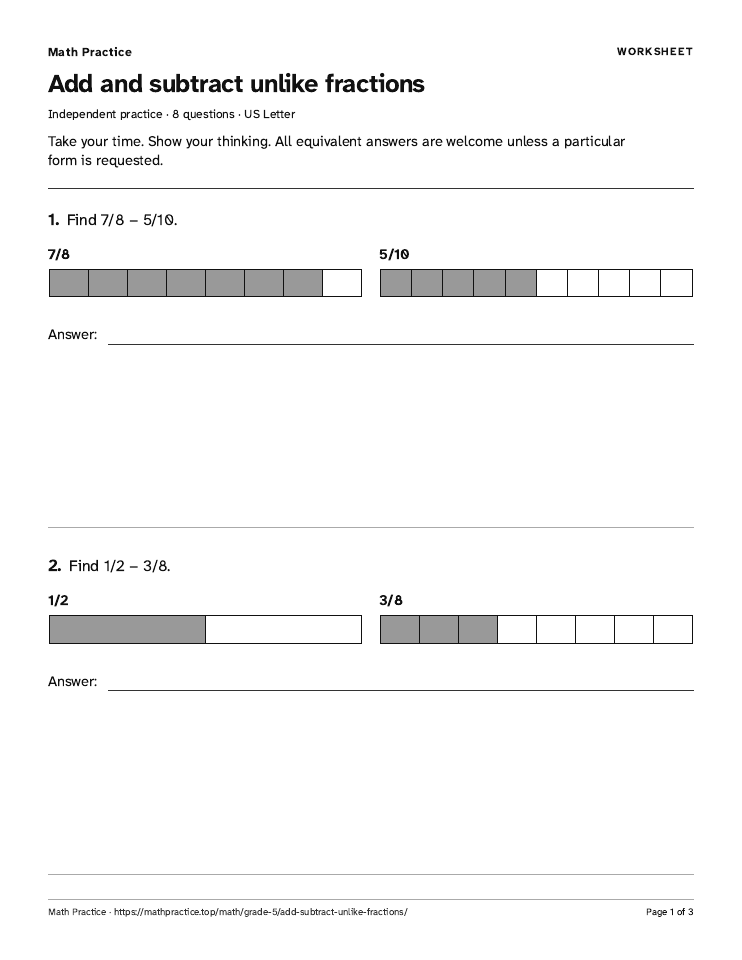
What equal-size pieces could represent both fractions? How will each numerator change?
What to look for
The learner renames both fractions accurately, performs the operation on numerators, and checks the size of the result.
A common sticking point
Changing a denominator without changing its numerator, or adding the original denominators.
Help without giving the answer
Align two equal-length bars. Split each into a part size that fits both original partitions, then recount the selected parts.
Keep the words clear
Words in this skill.
unlike denominators
Denominators that differ.
common denominator
A denominator that can be used to rename both fractions with equal-size parts.
least common denominator
The smallest positive denominator that both fractions can be renamed with.
equivalent fractions
Fractions that keep the same value while using different names.
What these sets cover.
Use denominators 2 to 12, with least common denominator no greater than 60.
Start where one denominator divides the other, then use pairs needing a new denominator.
Subtraction results stay nonnegative. Equivalent student answers are not restricted to the generator denominator list.
Common questions
Must I choose the least common denominator?
No. Another common denominator can work. The least one often keeps the numbers smaller. Equivalent final answers are accepted unless the task requests a form.
Why is 1/3 + 1/4 not 2/7?
A third and a fourth are different-sized pieces. Count equal-size pieces instead: they become four twelfths and three twelfths, totaling seven twelfths.
Try next
Mixed numbers: unlike denominators
Next, combine this common-denominator method with whole numbers and regrouping.