Fractions · Grade 5

Mixed numbers with unlike denominators

Use common denominators for the fractional parts and keep track of the wholes. Regroup only when the calculation needs it.

Grade 58 questions per setNo account needed

US Letter PDF · A4 version · Answer key

What we’re working onAdd and subtract mixed numbers with unlike denominators, including regrouping.

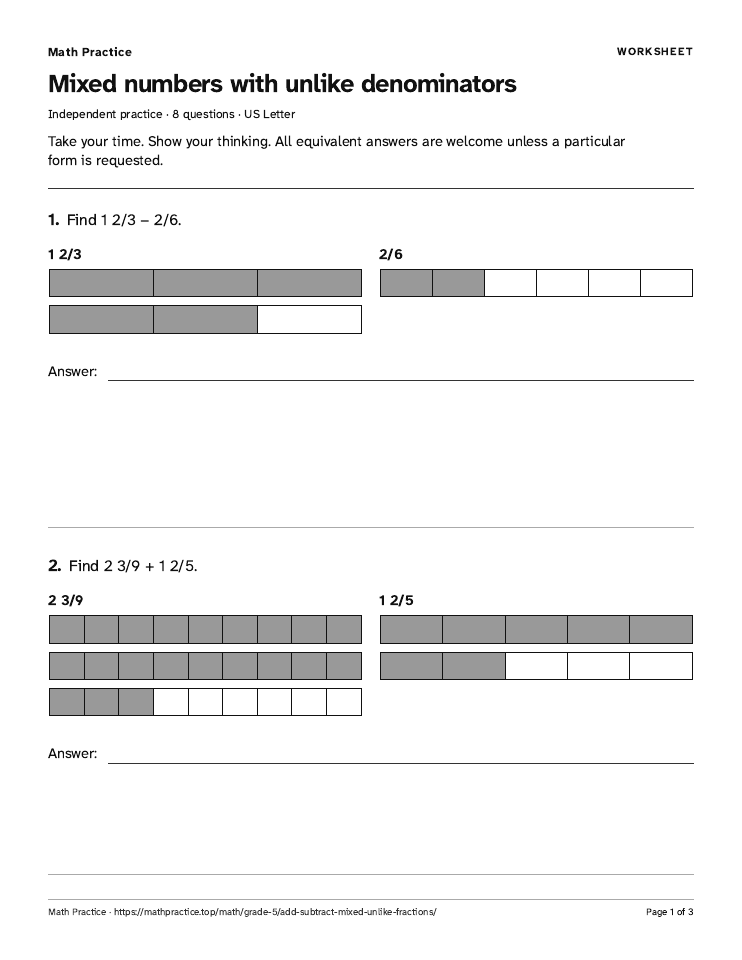
First page of the Mixed numbers: unlike denominators worksheet, with visible questions and room to work.Open worksheet PDF · 8 questions · US Letter
See how it works

Worked examples

Example 1

Add and regroup a whole

Find 1 2/3 + 2 3/4.

  1. Use twelfths: 2/3 = 8/12 and 3/4 = 9/12.
  2. Add the wholes to get 3. Add the fractions to get 17/12.
  3. Seventeen twelfths is one whole and five twelfths. Combine that whole with the other three.

1 2/3 + 2 3/4 = 4 5/12

Example 2

Rename, then subtract

Find 2 1/4 − 5/6.

  1. Use twelfths: 1/4 = 3/12 and 5/6 = 10/12.
  2. Regroup one whole: 2 3/12 = 1 15/12.
  3. Subtract ten twelfths from fifteen twelfths, keeping the remaining whole.

2 1/4 − 5/6 = 1 5/12

A question from this worksheet

Find 1 2/3 − 2/6.

See the explanation

4/3

1 2/3 − 2/6 = 10/6 − 2/6 = 4/3 = 1 1/3.

Choose how to practice

Pick the support you need.

Each set has eight questions. The online practice and prepared worksheet use the same questions.

Need a different version or paper size? Customize a worksheet

For the grown-up beside them

Help the thinking along.

A useful question

After you rename the fractions, do you have enough fractional parts to subtract? Where does each whole go?

What to look for

The learner changes both fractional names consistently and preserves the amount at every regrouping step.

A common sticking point

Regrouping a whole but forgetting to reduce the whole-number part by one.

Help without giving the answer

Keep a separate drawing for the wholes. Exchange one whole for fractional pieces and cross off only the exchanged whole.

Keep the words clear

Words in this skill.

mixed number
A whole number plus a proper fraction, written together.
common denominator
A shared denominator used to name equal-size parts.
regroup
Rewrite the same amount using different groups.
equivalent
Equal in value.

What these sets cover.

  • Start with common-denominator renaming that does not require regrouping.
  • Then include sums that make a new whole and differences that exchange a whole.
  • Generated denominators are 2 to 12, the least common denominator is at most 60, and subtraction results are nonnegative.

Common questions

Should I rename before regrouping?

That is often easiest: first choose a common denominator, then decide whether to exchange a whole. Converting both amounts to improper fractions is another valid method.

Can I subtract the smaller numerator from the larger one each time?

No. Subtraction has an order. If the first fractional part is too small, regroup a whole rather than reversing the fractional subtraction.

Try next

Fraction word problems

Next, choose when to use addition or subtraction in a story and interpret the answer with its unit.

Explore this skill

Related standards: 5.NF.1. These materials focus on this skill, not every part of a grade-level curriculum. How we check materials.