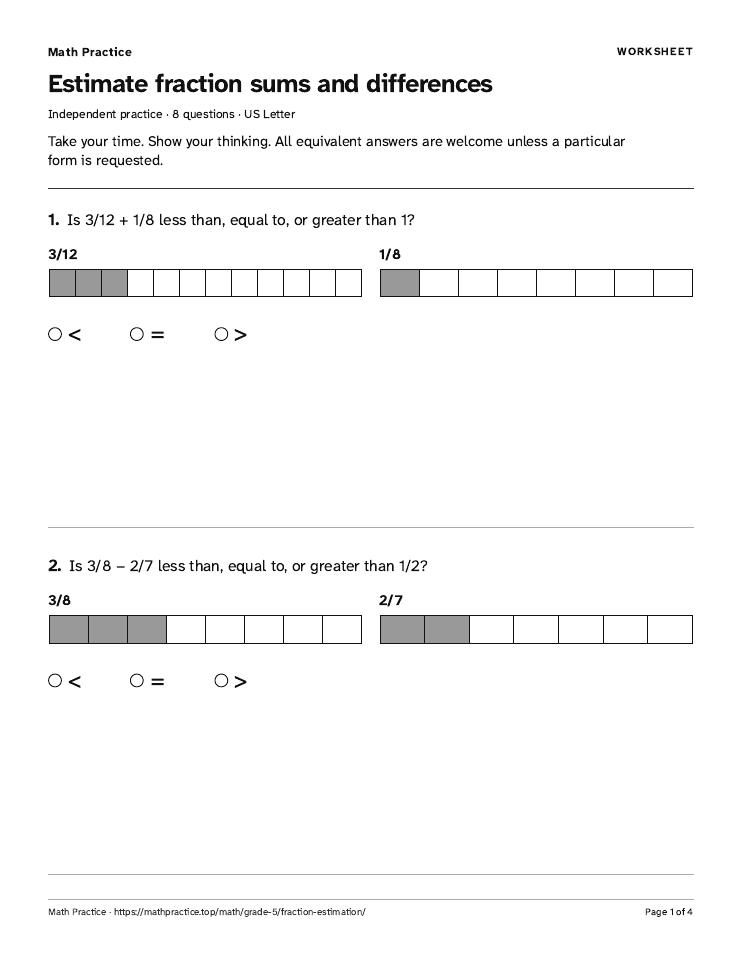
Which familiar value is each fraction near? Can you rule out an answer without finding the exact result?
What to look for
The learner gives a reason for a range and knows that an estimate does not have to equal the exact answer.
A common sticking point
Rounding every fraction down and treating that result as exact.
Help without giving the answer
Place the fractions beside 0, 1/2, and 1 on a line. Ask which side of a benchmark each value lies on.
Keep the words clear
Words in this skill.
estimate
Find an approximate amount or a useful range instead of an exact value.
benchmark
A familiar value used for comparison.
reasonable
Consistent with the size and meaning of the amounts in the problem.
range
A set of possible values between stated limits.
What these sets cover.
Begin with clear comparisons to 1/2 and 1.
Practice choices use disjoint ranges and avoid nearest-benchmark ties.
Generated unlike-denominator examples use denominators 2 to 12 and a least common denominator no greater than 60.
Common questions
Can different estimates both be useful?
Yes. Different benchmarks can give different useful approximations. In practice questions here, the choices name separate ranges so there is a clear answer.
Does estimating replace exact calculation?
No. It helps you predict and check the result. If a problem asks exactly how much remains, calculate the exact difference too.
Try next
Add and subtract unlike fractions
Next, find exact sums and differences by renaming unlike fractions with equal-size parts.