
Add past one whole
Find 5/6 + 3/6.
- Both fractions count sixths.
- Five sixths plus three sixths is eight sixths.
- Eight sixths contains one whole and two more sixths. The sum can be greater than 1.
5/6 + 3/6 = 8/6 = 4/3
When the denominators match, the parts have the same size. Add or subtract the number of those parts.
US Letter PDF · A4 version · Answer key
What we’re working onAdd and subtract fractions with like denominators, including results greater than one.
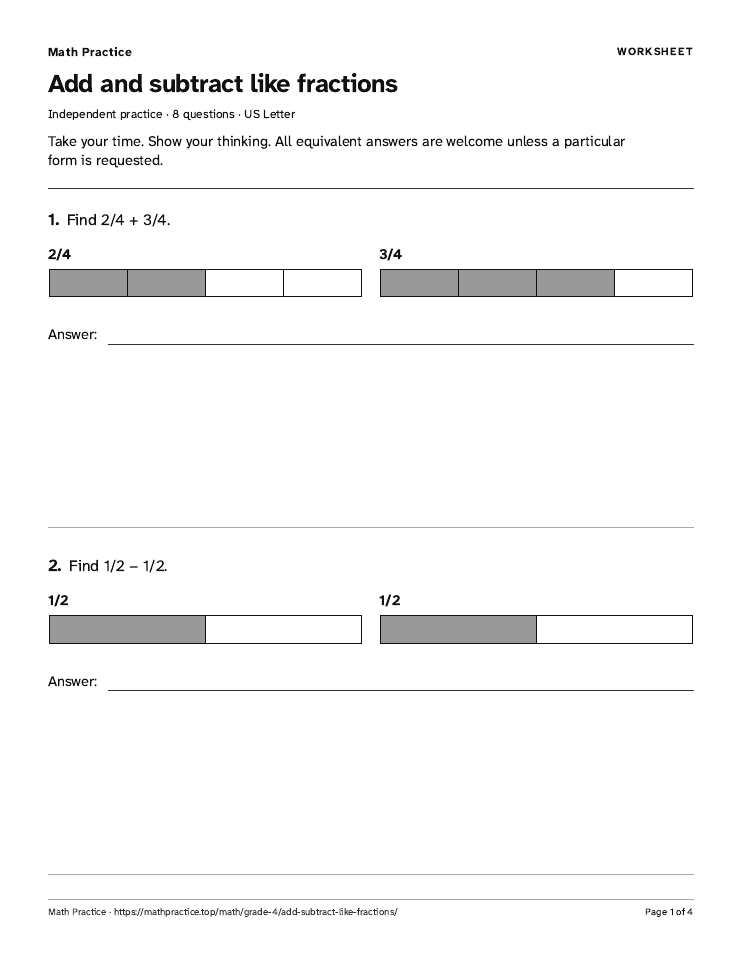 Open worksheet PDF · 8 questions · US Letter
Find 5/6 + 3/6.
5/6 + 3/6 = 8/6 = 4/3
Find 7/8 − 3/8.
7/8 − 3/8 = 4/8 = 1/2
5/4
2/4 + 3/4 = 2/4 + 3/4 = 5/4 = 1 1/4.
Each set has eight questions. The online practice and prepared worksheet use the same questions.
More models and smaller steps to make the idea clear.
Start 8 questionsA short set to try on your own, with help if you need it.
Start 8 questionsUse the idea in a new way and revisit an earlier skill.
Start 8 questionsNeed a different version or paper size? Customize a worksheet
What size are the parts? How many do we have after joining or removing them?
The learner keeps the denominator, counts the parts, and notices when the total crosses a whole.
Adding or subtracting the denominators, changing the size of the parts.
Label each piece with its unit fraction. Ask whether joining the pieces makes each individual piece smaller.
We are counting the same kind of part before and after the operation. Combining sixths gives more sixths; it does not turn them into twelfths.
Yes. It means the counted parts make more than one whole. An equivalent fraction remains correct unless a particular form is requested.
Keep counting hundredths: 65/100 + 58/100 = 123/100, which is more than one whole. Also, 70/100 − 35/100 = 35/100 = 7/20. The answer may have another denominator when it is renamed; its value stays the same.
Next, connect fractions greater than one to mixed numbers and regroup a whole when needed.
Related standards: 4.NF.3. These materials focus on this skill, not every part of a grade-level curriculum. How we check materials.