
Rename in twelfths
Complete 2/3 = ?/12.
- Each third splits into four equal parts, because 3 × 4 = 12.
- Each of the two selected thirds also splits into four.
- There are 2 × 4 = 8 selected twelfths.
2/3 = 8/12
Rename fractions by splitting or grouping equal parts. Change the numerator and denominator together to keep the value.
US Letter PDF · A4 version · Answer key
What we’re working onGenerate equivalent fractions and recognize a simpler equivalent form.
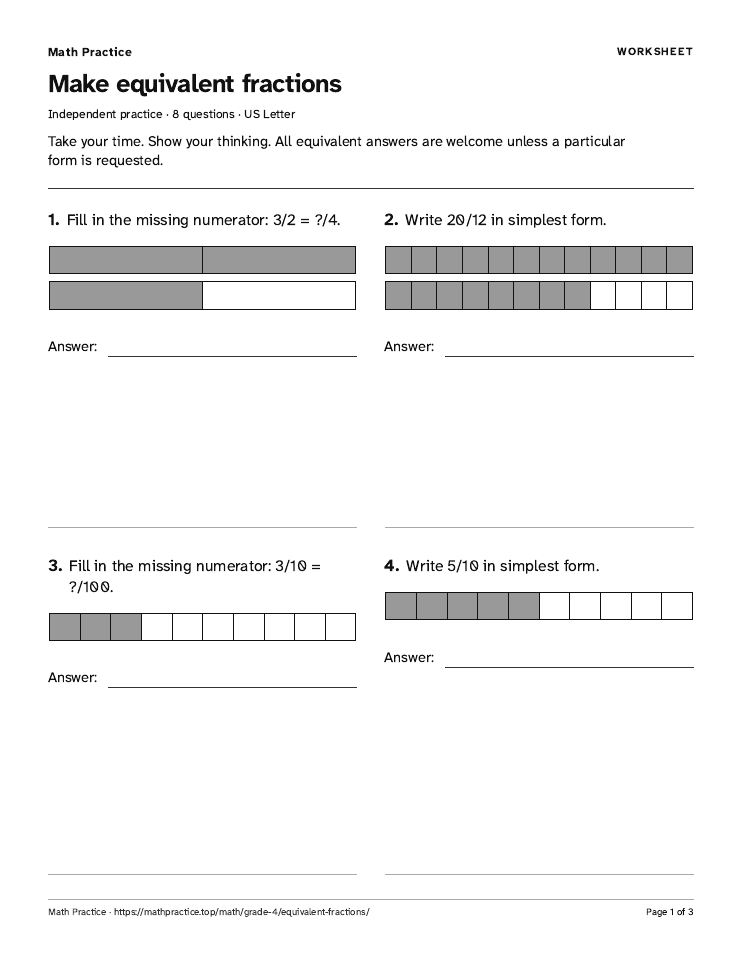 Open worksheet PDF · 8 questions · US Letter
Complete 2/3 = ?/12.
2/3 = 8/12
Write 6/8 in simplest form.
6/8 = 3/4
6
3/2 = (3 × 2)/(2 × 2) = 6/4. The whole and the shaded amount stay the same.
Each set has eight questions. The online practice and prepared worksheet use the same questions.
More models and smaller steps to make the idea clear.
Start 8 questionsA short set to try on your own, with help if you need it.
Start 8 questionsUse the idea in a new way and revisit an earlier skill.
Start 8 questionsNeed a different version or paper size? Customize a worksheet
How many new pieces does each old piece become? Did both numbers change by the same factor?
The learner links multiplication or division of both numbers to the unchanged amount in the model.
Adding the same number to the numerator and denominator instead of scaling both by the same factor.
Keep the original shaded amount visible. Split every part equally and ask the learner to count the new parts.
No. If the task only asks for the value, an equivalent fraction is correct. Use simplest form when the instructions specifically ask for it.
Each selected part and every part in the whole are split in the same way. There are more parts, but each one is proportionally smaller.
One tenth contains ten hundredths, so 3/10 = 30/100. In the other direction, 40/100 = 4/10 = 2/5. Grouping the parts changes their names, not the amount or the whole.
Next, use equivalent fractions or benchmarks to compare different denominators.
Related standards: 4.NF.1. These materials focus on this skill, not every part of a grade-level curriculum. How we check materials.