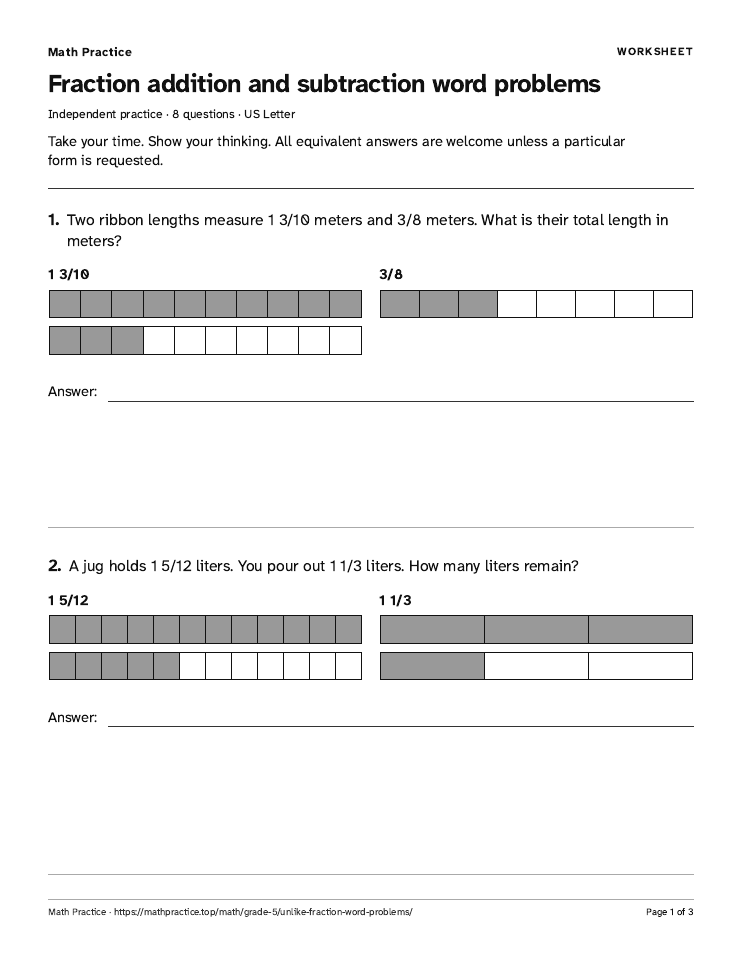
What is happening to the amount? What are we trying to find, and what unit will the answer use?
What to look for
The learner chooses the operation from the relationship in the story, estimates, and gives a sensible answer with a unit.
A common sticking point
Choosing an operation from a single keyword without considering which quantity is unknown.
Help without giving the answer
Sketch one bar for the total and label the known parts. Ask which part of the drawing the question is asking for.
Keep the words clear
Words in this skill.
quantity
An amount that can be counted or measured.
unit
The measure used for an amount, such as a meter or a mile.
estimate
A useful approximate amount or range.
difference
The result of subtracting one amount from another.
What these sets cover.
Start with one operation and the same unit throughout each story.
Introduce mixed-number stories after practicing mixed-number calculations.
This set does not require unit conversions, multiplication, or division of fractions.
Common questions
Does the word more always mean add?
No. A story might ask how much more one amount is than another; that compares two amounts by subtraction. Read the relationship and identify the unknown.
Why should I keep the unit in my answer?
The number alone does not say what was measured. Five sixths of a meter describes a length; five sixths of a cup describes a different kind of amount.
Related standards: 5.NF.2. These materials focus on this skill, not every part of a grade-level curriculum. How we check materials.