
Use one half
Compare 3/8 and 2/3.
- One half is 4/8, so 3/8 is less than one half.
- One half is also 3/6. Since 2/3 = 4/6, 2/3 is greater than one half.
- A number below one half is less than a number above one half.
3/8 < 2/3
Compare fractions with different numerators and denominators. Use a helpful benchmark or rename them with a shared part size.
US Letter PDF · A4 version · Answer key
What we’re working onChoose and explain a valid comparison strategy for unlike fractions.
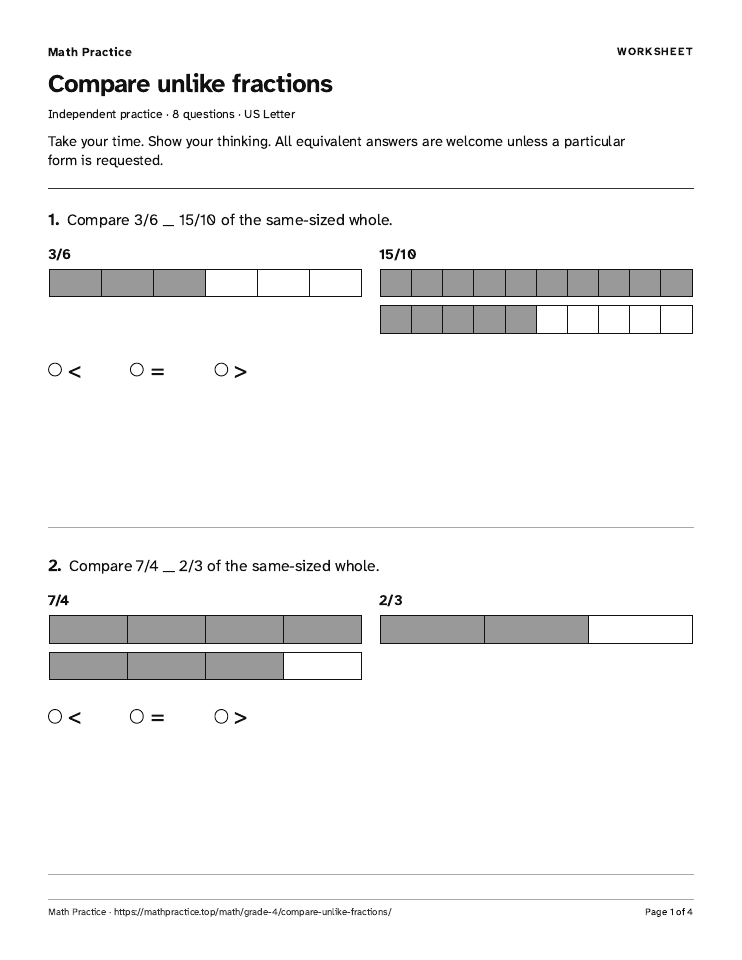 Open worksheet PDF · 8 questions · US Letter
Compare 3/8 and 2/3.
3/8 < 2/3
Compare 3/4 and 7/8.
3/4 < 7/8
<
3/6 < 15/10. Rename both with denominator 60: 30/60 and 90/60. Now each piece is the same size, so compare 30 and 90.
Each set has eight questions. The online practice and prepared worksheet use the same questions.
More models and smaller steps to make the idea clear.
Start 8 questionsA short set to try on your own, with help if you need it.
Start 8 questionsUse the idea in a new way and revisit an earlier skill.
Start 8 questionsNeed a different version or paper size? Customize a worksheet
Would one half or one whole separate these values? If not, what equal-size parts could compare them?
The learner gives a reason for the sign and uses the same unit in both models.
Comparing the numerator or denominator alone when both are different.
Mark one half on a number line. Place each fraction relative to it before asking for an exact comparison.
No. If one fraction is below 1/2 and the other is above 1/2, a benchmark settles the comparison.
Yes. For example, 2/3 and 4/6 have different numerators and denominators but the same value.
One half is 50/100. That makes 47/100 less than 1/2. To compare 65/100 with 3/5, rename 3/5 as 60/100: 65/100 is greater. Use the same-sized whole in both models.
Next, break a fraction into smaller amounts that add back to the same value.
Related standards: 4.NF.2. These materials focus on this skill, not every part of a grade-level curriculum. How we check materials.