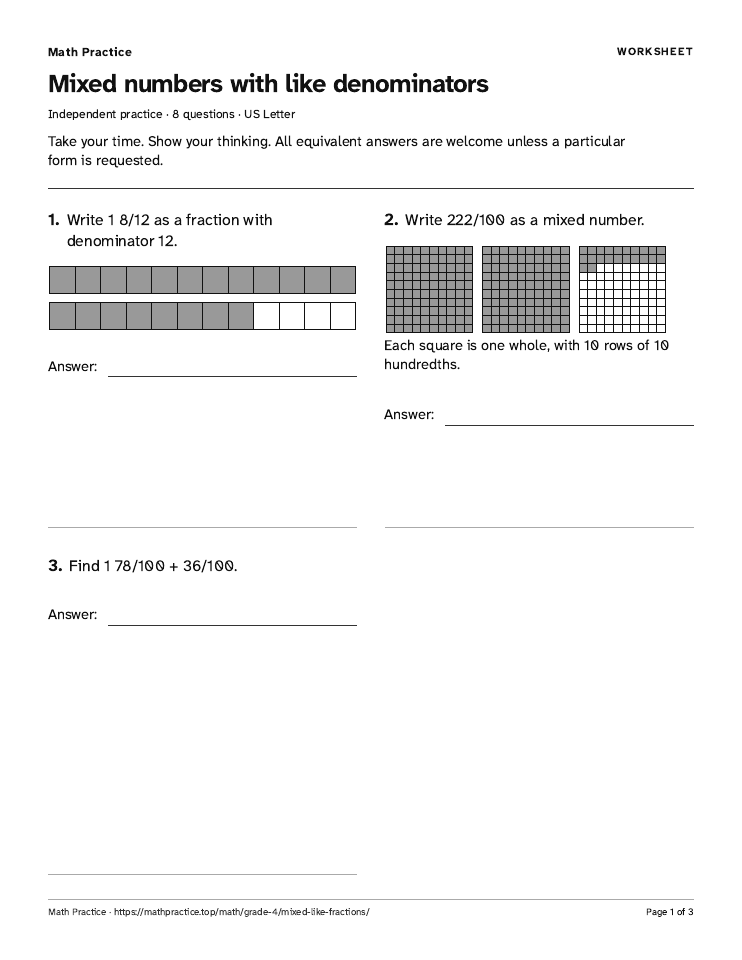
How many of these fractional parts equal one whole? What must change when you regroup that whole?
What to look for
The learner changes both the whole count and the fraction when regrouping, and can reverse the conversion.
A common sticking point
Adding just 1 to the numerator when exchanging one whole, instead of adding the denominator.
Help without giving the answer
Draw one whole split into the required parts. Move all of those parts next to the fractional part and recount.
Keep the words clear
Words in this skill.
mixed number
A whole number plus a proper fraction, written together, such as 2 3/4.
improper fraction
A fraction whose numerator is at least as large as its denominator.
regroup
Rewrite the same amount using different-sized groups.
proper fraction
A nonnegative fraction with numerator smaller than denominator.
hundredth
One of 100 equal parts of one whole, written 1/100.
What these sets cover.
Practice mixed-to-improper and improper-to-mixed conversion before regrouping.
Start without regrouping, then exchange one whole when needed.
Keep subtraction results nonnegative. Equivalent answers work unless a mixed number is requested.
For hundredths, exchanging one whole adds 100 to the fractional-part count and subtracts 1 from the whole count.
Common questions
Do I have to use improper fractions to subtract?
No. You may regroup a whole in a mixed number or convert the whole amount into an improper fraction. Both methods keep the value unchanged.
How do I add mixed numbers with the same denominator?
Add the wholes and add the fractional parts. If the fractional sum contains a whole, regroup it. For example, 1 3/4 + 2 2/4 = 3 + 5/4 = 4 1/4.
How do I regroup one whole into hundredths?
In 2 15/100 − 75/100, trade one of the two wholes for 100 hundredths. Now subtract from 1 115/100: the result is 1 40/100, or 1 2/5. The whole count decreases by one when the fraction count increases by 100.
Try next
Estimate fraction answers
Next, use familiar benchmarks to judge whether an addition or subtraction answer is reasonable.