See how it works
Worked examples
Example 1Split each third in two
A bar shows 2/3. Split each third into two equal parts. What fraction now names the shaded amount?
- The whole bar still has the same length.
- Three thirds become six equal parts, so the new parts are sixths.
- The two shaded thirds become four shaded sixths.
2/3 = 4/6
Example 2Split each fourth in two
A bar shows 3/4. Divide every fourth into two equal parts without changing the shaded area.
- Four fourths become eight equal parts.
- Each shaded fourth becomes two shaded eighths.
- The three shaded fourths become six shaded eighths.
3/4 = 6/8
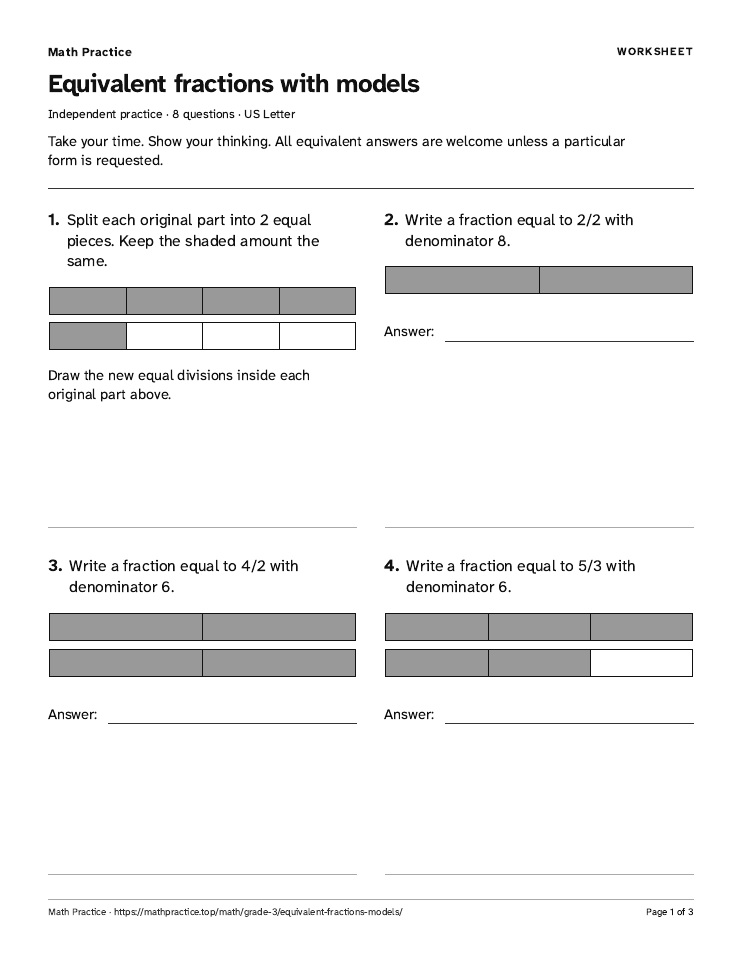
A question from this worksheetSplit each original part into 2 equal pieces. Keep the shaded amount the same.
See the explanation
Split each original part into 2 equal pieces: 10/8.
5/4 = (5 × 2)/(4 × 2) = 10/8. The whole and the shaded amount stay the same.
Choose how to practice
Pick the support you need.
Each set has eight questions. The online practice and prepared worksheet use the same questions.
Learn the ideaBuild understanding
More models and smaller steps to make the idea clear.
Start 8 questions Try it yourselfIndependent practice
A short set to try on your own, with help if you need it.
Start 8 questions Come back to itReview & apply
Use the idea in a new way and revisit an earlier skill.
Start 8 questions Need a different version or paper size? Customize a worksheet
For the grown-up beside themHelp the thinking along.
A useful question
What changed about the parts? What stayed the same about the whole and the shaded amount?
What to look for
The learner explains that smaller parts require more pieces to represent the same value.
A common sticking point
Changing the denominator while leaving the numerator unchanged.
Help without giving the answer
Draw the new dividing lines through every part, including unshaded parts. Then recount the shaded parts.
Keep the words clearWords in this skill.
- equivalent fractions
- Fractions that name the same number.
- partition
- Divide a whole or a part into smaller equal parts.
- unit fraction
- One equal part of a whole, such as 1/6.
What these sets cover.
- Both generated denominators stay within 2, 3, 4, 6, and 8.
- Begin with values up to 1; use values up to 2 only after seeing fractions beyond one.
- A task that asks for a particular split also checks that structure, not just an equal value.
Common questions
Do equivalent fractions land at the same point?
Yes. On a number line with the same unit, equivalent fractions have exactly the same position.
Can I change just the denominator?
Usually that changes the value. When you split every part into two, both the total number of parts and the number selected double.
Try nextCompare familiar fractions
Next, compare fractions when either the part size or the number of parts is the same.
Explore this skill