Fractions · Grade 4

Decompose fractions

Break a fraction into a sum in more than one way. Keep the size of each part and check that the total stays the same.

Grade 48 questions per setNo account needed

US Letter PDF · A4 version · Answer key

What we’re working onWrite a fraction as a sum of positive fractions with a specified denominator.

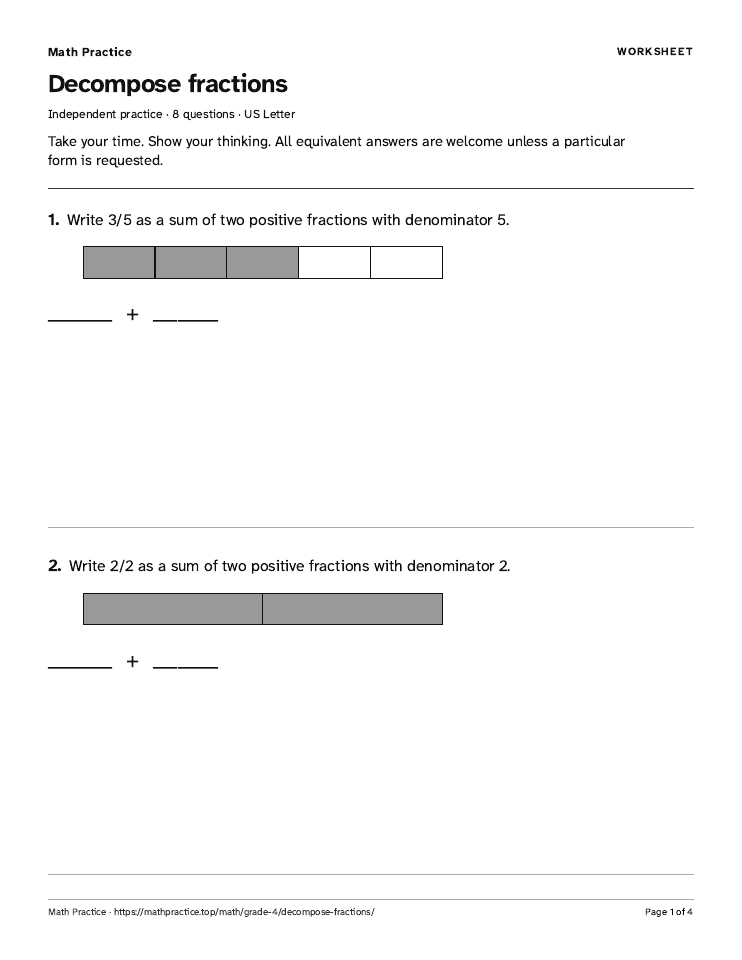
First page of the Decompose fractions worksheet, with visible questions and room to work.Open worksheet PDF · 8 questions · US Letter
See how it works

Worked examples

Example 1

Two ways to split the same amount

Write 5/6 as a sum of two positive fractions with denominator 6 in two different ways.

  1. Think of five separate sixths.
  2. Put one sixth in one group and four sixths in the other.
  3. Or put two sixths in one group and three sixths in the other. Both ways use all five sixths.

5/6 = 1/6 + 4/6 = 2/6 + 3/6

Example 2

Separate a whole

Write 7/4 as a sum of two positive fractions with denominator 4. Make one part a whole.

  1. Four fourths make one whole.
  2. Split seven fourths into four fourths and the remaining three fourths.
  3. Adding the two parts restores all seven fourths.

7/4 = 4/4 + 3/4

A question from this worksheet

Write 3/5 as a sum of two positive fractions with denominator 5.

See the explanation

1/5 + 2/5 (other positive sums with denominator 5 are valid)

One possible sum is 1/5 + 2/5. Any two positive numerators totaling 3, each over 5, work; either order is valid.

Choose how to practice

Pick the support you need.

Each set has eight questions. The online practice and prepared worksheet use the same questions.

Need a different version or paper size? Customize a worksheet

For the grown-up beside them

Help the thinking along.

A useful question

How many parts are there altogether? Can you make a different pair with the same total?

What to look for

The learner preserves the total, accepts more than one decomposition, and can include complete wholes.

A common sticking point

Thinking the first shown pair is the only correct answer.

Help without giving the answer

Use counters to stand for equal fractional pieces. Split them into two nonempty groups and try another split.

Keep the words clear

Words in this skill.

decompose
Break a number into parts that add to that number.
sum
The result of adding two or more numbers.
addend
A number being added.
positive
Greater than zero.
hundredth
One of 100 equal parts of one whole, written 1/100.

What these sets cover.

  • Begin with fractions below 1; then separate complete wholes from fractions above 1.
  • Keep the requested denominator and use two positive terms.
  • Other sums may be mathematically equal but not match a stated structure.
  • For hundredths, group 100 equal parts as one whole; keep the requested denominator in both positive terms.

Common questions

Does the order of the parts matter?

No. For example, 1/6 + 4/6 and 4/6 + 1/6 are the same two-part decomposition in a different order.

Can I use zero as one part?

A sum with zero can have the correct total, but these tasks ask for two positive parts. Each part must be greater than zero.

Can I separate a whole from a fraction written in hundredths?

Yes. For 125/100, count one group of 100 hundredths and 25 more: 125/100 = 100/100 + 25/100. Both parts are positive. Another split, such as 60/100 + 65/100, works too.

Try next

Add and subtract like fractions

Next, combine or take away fractions whose parts have the same size.

Explore this skill

Related standards: 4.NF.3.b. These materials focus on this skill, not every part of a grade-level curriculum. How we check materials.