See how it works
Worked examples
Example 1Count spaces from zero
The space from 0 to 1 is divided into six equal intervals. What number is four intervals to the right of 0?
- The distance from 0 to 1 is one whole.
- Each interval has length 1/6.
- Starting at 0, move four intervals: 1/6, 2/6, 3/6, 4/6.
4/6, which is also 2/3
Example 2Go beyond one
Each whole unit on a number line is split into four equal intervals. Locate 5/4.
- Each interval has length 1/4.
- Four intervals reach 4/4, which is 1.
- One more interval reaches 5/4. It is between 1 and 2.
The first fourth-length interval after 1.
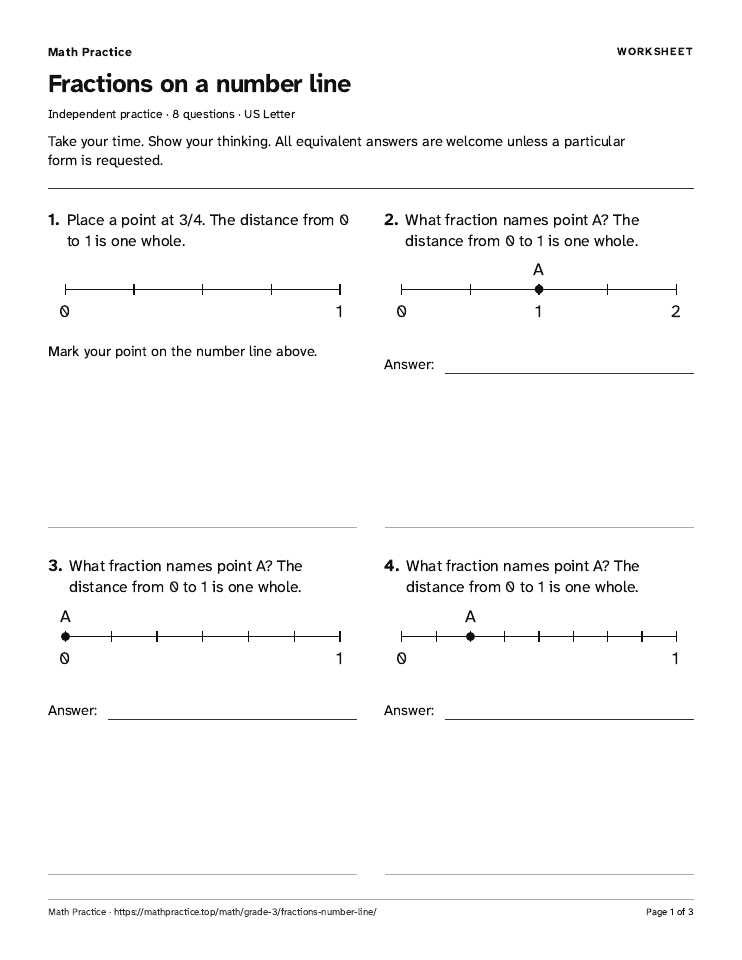
A question from this worksheetPlace a point at 3/4. The distance from 0 to 1 is one whole.
See the explanation
3/4
A is 3 spaces of 1/4 from zero: 3/4.
Choose how to practice
Pick the support you need.
Each set has eight questions. The online practice and prepared worksheet use the same questions.
Learn the ideaBuild understanding
More models and smaller steps to make the idea clear.
Start 8 questions Try it yourselfIndependent practice
A short set to try on your own, with help if you need it.
Start 8 questions Come back to itReview & apply
Use the idea in a new way and revisit an earlier skill.
Start 8 questions Need a different version or paper size? Customize a worksheet
For the grown-up beside themHelp the thinking along.
A useful question
Where are 0 and 1? What distance does one small space represent?
What to look for
The learner counts intervals from zero and keeps each whole unit the same length beyond 1.
A common sticking point
Counting the mark at zero as the first fractional step.
Help without giving the answer
Trace the first space from 0 with a finger. Label its length, then count spaces rather than marks.
Keep the words clearWords in this skill.
- number line
- A line that shows numbers at positions with a consistent scale.
- unit interval
- The distance from 0 to 1; one whole unit.
- interval
- The space between two positions on the line.
- equivalent fractions
- Different fraction names for the same number.
What these sets cover.
- Begin on 0 to 1; extend to 0 to 2 after the unit is clear.
- Use denominators 2, 3, 4, 6, and 8.
- Equivalent names are accepted unless a particular denominator is explicitly requested.
Common questions
Why do four equal spaces need five marks?
The marks show both ends of each space. Include 0 and 1: four spaces have five boundary marks.
Can a fraction be greater than 1?
Yes. Once you have counted all the fractional parts in one whole, keep going with parts of the same size.
Try nextWhole numbers as fractions
Next, see why whole numbers can also be written as fractions.
Explore this skill