Fractions · Grade 2

Equal shares: halves, thirds, fourths

Find equal shares before naming halves, thirds, and fourths. The parts must have equal area, even when their shapes differ.

Grade 28 questions per setNo account needed

US Letter PDF · A4 version · Answer key

What we’re working onTell whether a whole is split into equal shares and name one share.

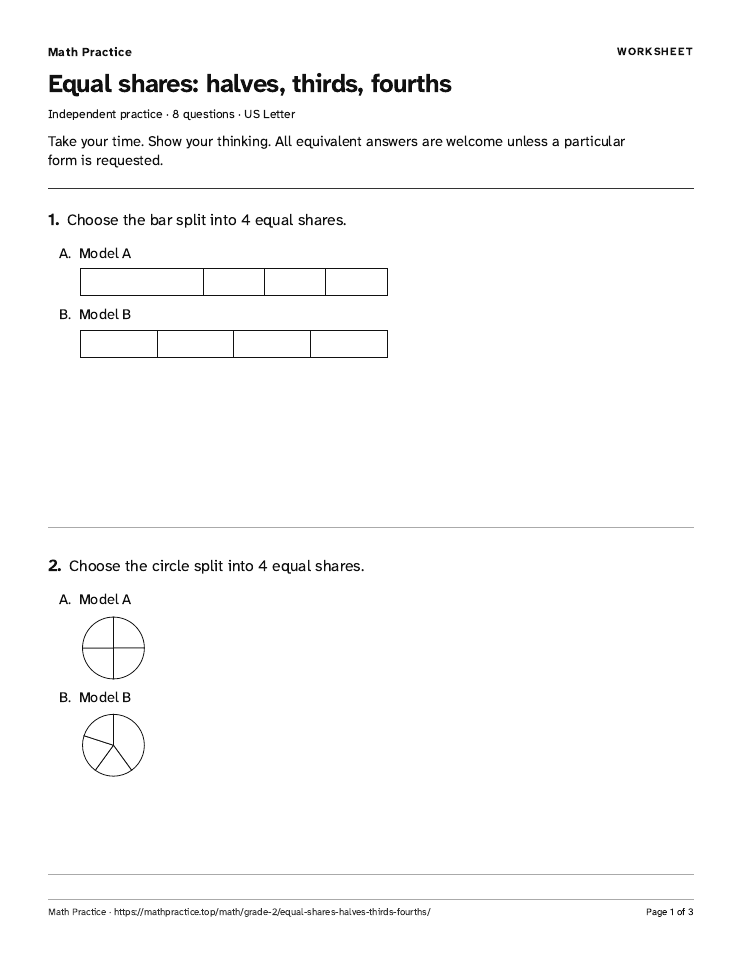
First page of the Equal shares worksheet, with visible questions and room to work.Open worksheet PDF · 8 questions · US Letter
See how it works

Worked examples

Example 1

Two equal shares

Fold a rectangular sheet in half so the two parts cover each other. What is each part called?

  1. The whole is one sheet of paper.
  2. The fold makes two parts with the same area.
  3. Each of the two equal shares is one half.

Each part is one half.

Example 2

Four pieces are not always fourths

A rectangle is made from four equal squares in a row. One piece contains two squares; the other two pieces contain one square each. Are the three pieces thirds?

  1. Count the pieces: there are three.
  2. Compare their areas: the largest covers two squares, but each smaller piece covers one.
  3. Thirds must be three equal shares of the whole. These shares are unequal.

No. The three pieces do not have equal area.

A question from this worksheet

Choose the bar split into 4 equal shares.

See the explanation

Model B

A whole split into 4 equal shares has fourths. Counting pieces alone is not enough: their areas must match.

Choose how to practice

Pick the support you need.

Each set has eight questions. The online practice and prepared worksheet use the same questions.

Need a different version or paper size? Customize a worksheet

For the grown-up beside them

Help the thinking along.

A useful question

What is the whole? How could you check that the parts have the same area?

What to look for

The learner checks the size of each share, not just the number of pieces.

A common sticking point

Calling any three pieces thirds, even when one piece is larger.

Help without giving the answer

Use an identical paper rectangle. Fold or cover the parts to compare their areas before naming them.

Keep the words clear

Words in this skill.

whole
The complete shape or amount being shared.
equal shares
Parts of the same whole that have equal area or equal amount.
half
One of two equal shares of a whole.
third
One of three equal shares of a whole.
fourth
One of four equal shares of a whole; also called a quarter.

What these sets cover.

  • Start with matching halves of a rectangle. Then compare thirds and fourths.
  • Use circles and rectangles. Check equal area rather than relying on appearance.
  • This page introduces equal shares without fraction calculations.

Common questions

Do equal shares have to look alike?

No. Shares can have different shapes and still have equal area. Covering them with the same number of equal squares can help you check.

Should we write fraction symbols yet?

Naming halves, thirds, and fourths is enough here. The next skill connects one equal share to a fraction such as 1/4.

Try next

Unit fractions

Next, connect the name of one equal share to a fraction with numerator 1.

Explore this skill

Related standards: 2.G.3. These materials focus on this skill, not every part of a grade-level curriculum. How we check materials.